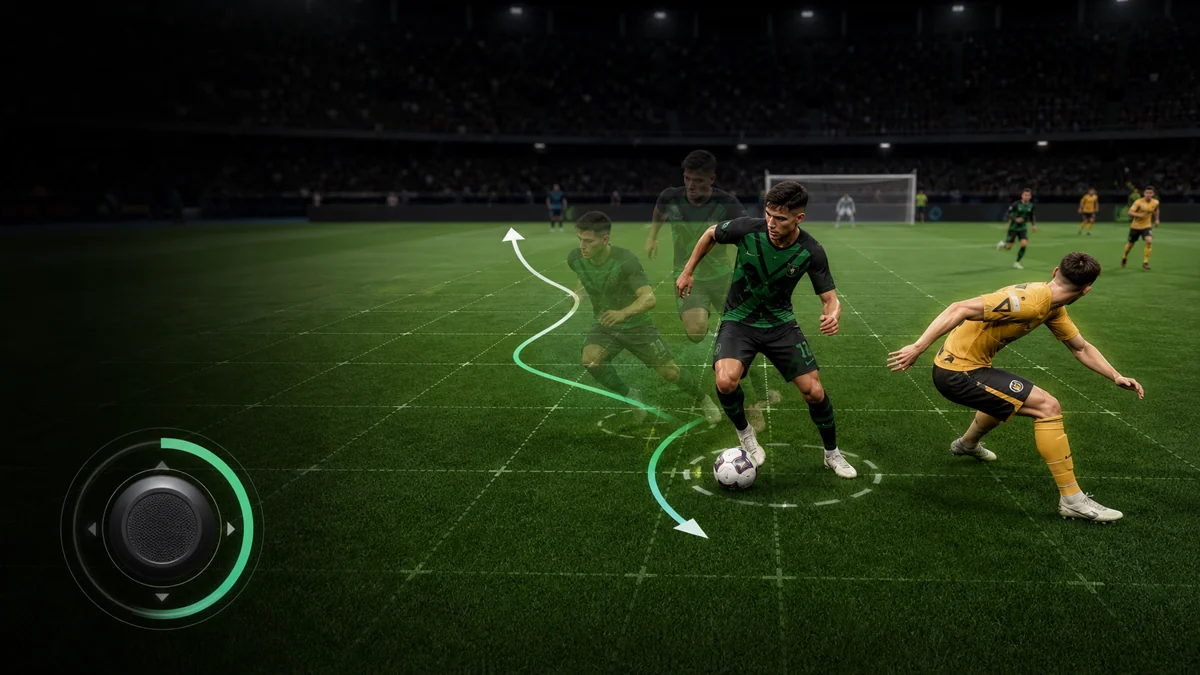
Quick answer: the fastest left-stick turns in eFootball do not begin after your player has finished facing a direction. The next input begins slightly earlier, while the current turning animation is still settling. Mednasah demonstrates this with a simple up-and-down sequence: move one way, reverse the left stick before the player's body has fully shifted, then let the next touch carry the player away. The result is a tighter, less predictable change of direction without relying on a skill-move combination.
That one timing detail only works when the rest of the dribble is clean. A heavy first touch, constant dash input or a reception aimed directly at a defender destroys the setup before the quick turn begins. This masterclass therefore starts where Mednasah starts: control the first touch, keep the ball on the protected side, understand automatic shielding, and dribble for a reason. The early reverse input is the final layer, not a shortcut around the basics.
What is the quick-turn technique?
Point the left stick in the first direction, then input the next direction just before the player's body and hips fully settle. The command is early, but controlled: one deliberate reversal timed to a close touch, not random left-stick spam.
Why normal direction changes feel slow
Most players use a visible-body cue. They hold the first direction, watch the player rotate until the chest and feet face that direction, and only then move the stick again. This is safe, but it creates a pause between decisions. The defender sees the same completed body shape you see, so the next exit is easier to track. You are effectively waiting for one animation to finish before requesting another.
Mednasah changes the cue. Instead of waiting for the body to finish the turn, he reads the touch that starts it. Once the ball and momentum are committed enough to sell the first direction, he enters the reverse direction before the player's weight completely follows. eFootball can then blend the next movement sooner. The deception comes from a mismatch: the defender reacts to the first body shift, while your next input is already preparing the exit.
This is not an animation cancel and it does not guarantee an instant turn with every player. It is an input-timing method. Player attributes, body orientation, ball distance, connection quality and the angle between the two directions still matter. Think of it as removing your own late input from the sequence, not removing the game's physical movement.
Foundation one: receive without sprinting into pressure
The first common mistake in the tutorial is controlling the ball while sprinting. Dash dribbling pushes the ball farther from the feet. That is useful when open grass is available, but dangerous when a defender is already close enough to challenge. A long touch gives the defender a larger window to step across your route, and it also delays the moment when you can make a clean second-direction input.
Before the pass arrives, release dash and decide where the pressure is coming from. Your first movement should take the ball away from that pressure or place your player's body between the defender and the ball. Do not receive toward the defender simply because that direction points toward goal. The safest first touch is often sideways or slightly backward, because it preserves possession and opens the next passing or dribbling angle.
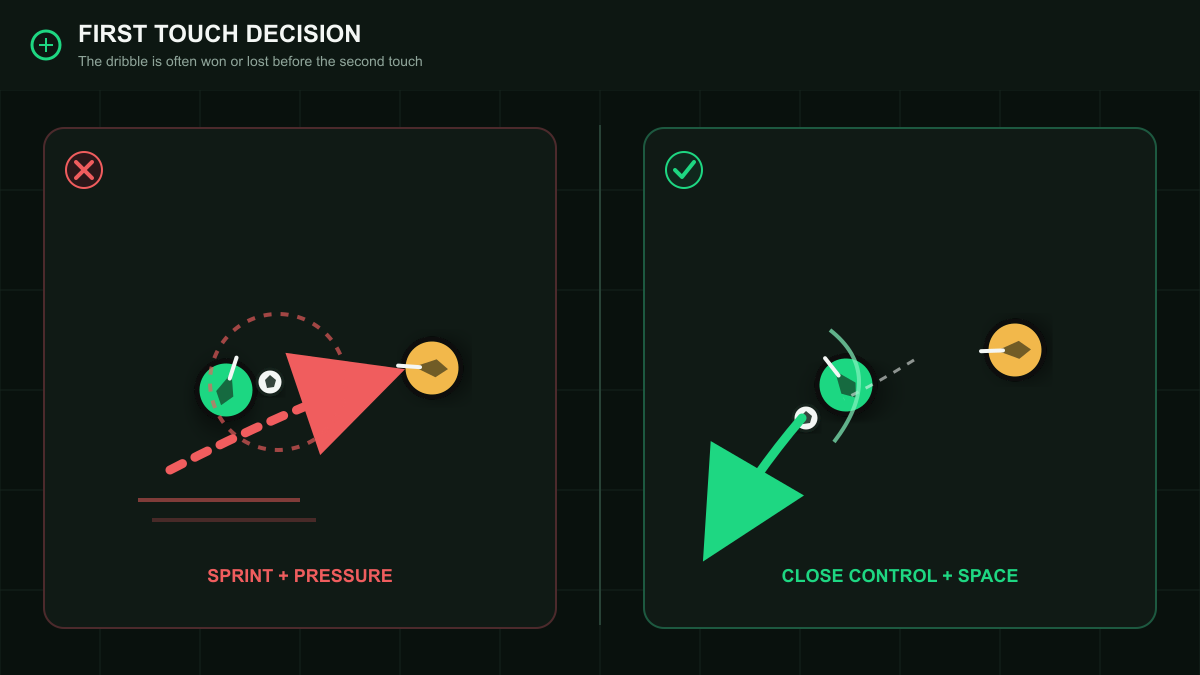
A three-question scan before the ball arrives
Read the reception before touching the stick
- Where is the nearest defender coming from: front, side or behind?
- Which side of my player keeps the body between that defender and the ball?
- After the first touch, do I need to protect, pass, turn or accelerate into space?
If you answer those questions early, dribbling becomes a planned sequence instead of an emergency. The first touch creates the angle, the quick turn manipulates the defender, and dash is used only after the exit is open. Players who struggle with left-stick dribbling often try to solve all three moments with one continuous stick-and-sprint input. Separating them immediately improves control.
Foundation two: safe dribbling means avoiding the duel
Traditional safe dribbling puts your player between the ball and the defender. That principle still matters, but Mednasah adds an important adjustment for the current physical game: body position is protection, not permission to stay in contact forever. Defenders can still recover from behind, force a shoulder challenge or reach around a slow turn. The strongest protection is to leave the defender's reach before a second contact arrives.
Use small directional changes to keep the ball on the far side. If the defender closes from your right shoulder, move the ball left or diagonally away while keeping your torso in the channel between both players. Avoid turning in a full circle just to preserve possession. Every extra touch gives support defenders time to surround you. Protect for one moment, identify the free angle, then escape.
How automatic shielding actually fits the move
Konami's v4.0 gameplay notes explain that the manual Shield command was removed and players now attempt to protect the ball automatically when an opponent challenges from the side or behind. The same notes state that the player with higher Physical Contact has an advantage during contact. That supports the practical lesson in Mednasah's video: you control the angle and movement, while the game decides when the body-protection animation activates.
Mednasah also tests a community claim that automatic shielding needs at least 75 Physical Contact. His Zico triggers shielding at both 75 and 74, so the video does not support treating 75 as a confirmed hard threshold. Do not damage a dribbler's useful build just to chase one rumored number. Physical Contact matters in a duel, but the better priority is still to avoid giving the defender a clean second challenge.
The crucial interaction is simple. While your player is shielding, a movement command away from the defender ends the protective posture and starts the dribble in that direction. This is why the quick-turn concept is valuable in contact: the body buys a short window, and an early, well-chosen exit input uses that window before the defender can reset.

The quick-turn input, step by step
One complete direction-change cycle
- Release dash and establish close control. The ball must be near enough for a responsive next touch.
- Move the left stick deliberately toward direction A. Let the player begin shifting the ball and body.
- Watch the first touch and hip movement, not the completed turn. Once direction A is believable, prepare direction B.
- Input direction B before the player fully faces direction A. Use a clean angle rather than rotating the stick randomly.
- Let the next touch carry the ball into direction B. If the defender commits, accelerate only after the lane is open.
- Reset to close control before repeating. Every reversal needs its own touch and purpose.

Early does not mean immediate
If you reverse the stick before the first movement has communicated anything, the player may barely shift or may take an untidy touch between directions. The first direction needs enough time to move the defender's attention. Your target is the small window after the player begins the turn but before the body fully settles. The exact window changes with player responsiveness, incoming ball speed and online delay.
A useful visual cue is the plant foot. When the player starts loading the foot that would complete direction A, enter direction B. A useful ball cue is the first controlled touch moving away from the original line. Do not wait for the chest to face the new direction. In training, slow your eyes down: ball touch first, hips second, chest last. Your input should usually arrive between the first two cues.
Follow natural angles instead of fighting the body
Mednasah says to follow natural dribbling directions. That matters because a clean diagonal reversal is more reliable than demanding repeated 180-degree spins while the ball is outside the player's base. Start with 45- to 90-degree changes: up to down on the screen when the player's body is side-on, diagonal inside to diagonal outside on the wing, or a short backward touch followed by a forward exit.
Once those movements are consistent, widen the angle. If a turn produces a heavy touch, the problem is usually one of four things: dash was still active, the ball was too far away, direction B arrived too late, or the requested angle ignored the player's current body shape. Correct one variable at a time rather than moving the stick faster.
Why Mednasah's Barella example matters
The tutorial demonstrates the sequence with Barella, not a specialist usually selected only for elite dribbling. The point is that input timing changes what a normal responsive midfielder can do. A top dribbler can make the same pattern tighter and cleaner, but you do not need a rare card to begin learning it. This is a transferable control skill before it is a player-card advantage.
Better dribblers still increase the margin for error. Ball Control helps with receptions, Dribbling supports control while moving, Tight Possession is especially relevant to low-speed turns in crowded areas, and Balance helps the player remain stable through changes of direction. Physical Contact matters when the duel cannot be avoided. These attributes support different parts of the sequence; one high number does not replace good timing.
- Ball Control: cleaner first touch and faster readiness for the next command.
- Tight Possession: more controlled low-speed turns when space is limited.
- Dribbling: ball carrying quality once the player is moving.
- Balance: stability while shifting weight and absorbing light pressure.
- Physical Contact: a better chance in unavoidable shoulder-to-shoulder moments.
- Gamesmanship skill: can increase the chance of winning a foul when a defender mistimes contact.
Gamesmanship: the secondary reward for good timing
Quick turns force the defender to make a decision while your ball touches remain tight. If the opponent commits to a shoulder challenge or tackle after you have already changed angle, contact can arrive late. Mednasah highlights Gamesmanship because players with that skill are more likely to win fouls in these situations. Around the penalty area, one correctly timed reversal can therefore create either an escape lane or a set piece.
Do not dribble toward contact simply to search for a foul. That makes possession depend on the referee animation and the defender's attributes. The technique is successful when you move beyond the challenge. A free kick is a useful consequence of the defender being late, not the main objective of the move.
Five match situations where the technique is strongest
Use the turn to solve a specific problem
- Isolated winger: fake the run toward the touchline, reverse inside before the full turn, then pass or accelerate.
- Half-space receiver: receive away from the nearest midfielder, show a return pass, then reverse into the gap beside him.
- Back to goal: allow one shielding contact, turn away from the defender's strong side and release the ball before support arrives.
- Edge of the box: use one short reversal to create half a yard for a shot or final pass instead of chaining skill moves.
- Press escape: show the safe backward route, reverse across the presser's line and open a new passing angle.
In all five cases, the dribble changes the geometry of the attack. You are not trying to collect a highlight. You are trying to move a defender one step away from the passing lane, shooting lane or open grass you actually want. The best outcome is often a simple pass made possible by the fake direction.
When you should not use it
Mednasah closes with the most important limitation: dribbling is situational. If you already have clear space, sprint into it. If a first-time pass breaks the press, play it. If two defenders have closed both exits, protect the ball and recycle possession. A quick turn is valuable only when one defender is reading your initial direction and a second route remains available.
- Do not repeat reversals in the same spot until a second defender arrives.
- Do not try it while a loose ball is still beyond close-control distance.
- Do not receive toward pressure just to create a dribbling duel.
- Do not hold dash throughout the turn and expect tight touches.
- Do not ignore a free teammate because the dribble worked once.
- Do not use the same fake direction every possession; good opponents learn patterns.
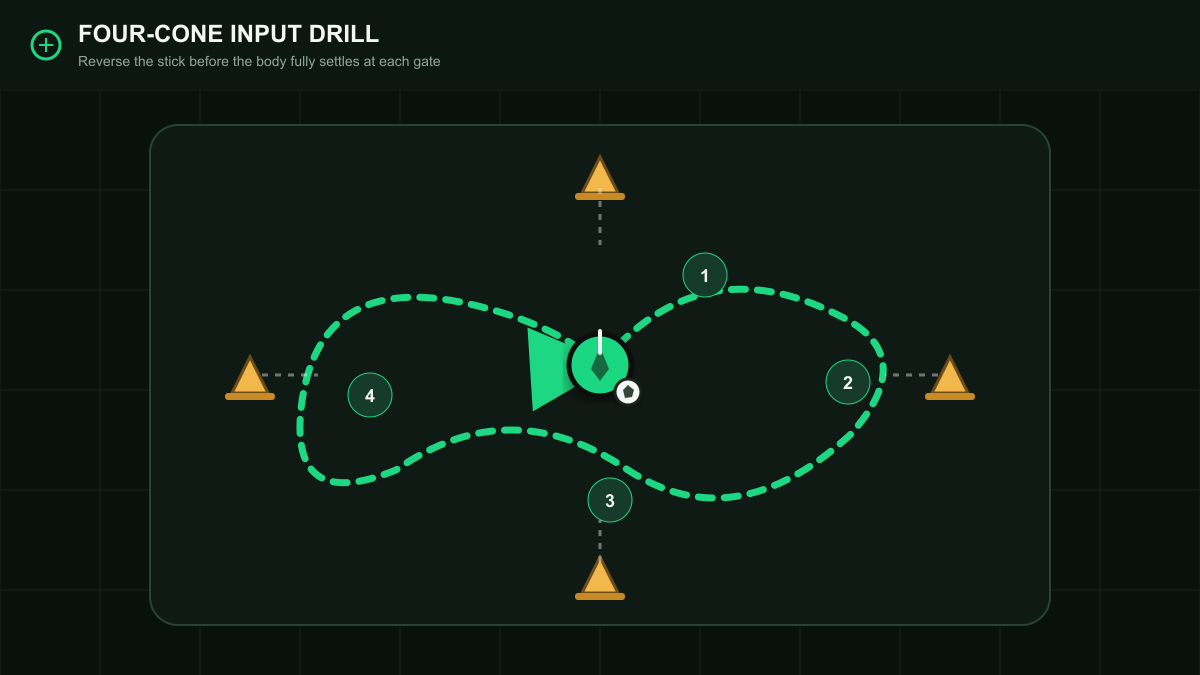
The four-cone drill for building the timing
Use Free Training and place your dribbler mentally inside a four-cone square. Move toward the first gate at normal dribble speed. Before the body fully faces that gate, reverse toward the next one. Continue in a figure-eight pattern. The aim is not maximum speed. The aim is to produce the same small touch, early input and clean exit four times in succession without dash.
Ten-minute practice progression
- Minutes 0-2: receive passes without dash and take every first touch away from the nearest defender.
- Minutes 2-4: alternate only two directions with a responsive midfielder. Count ten clean reversals in a row.
- Minutes 4-6: run the four-cone figure eight and vary the angle from 45 to 90 degrees.
- Minutes 6-8: add a passive defender. Shield once, exit once, then pass. Never hold the duel.
- Minutes 8-10: use an active defender and score only after the turn creates a passing or shooting lane.
A seven-day plan to make it usable online
One focus per day
- Day 1 - First touch: play without dash for the first second after every reception.
- Day 2 - Body protection: keep the player between ball and defender, then leave after one contact window.
- Day 3 - Two-direction rhythm: practice ten sets of up-down or inside-outside reversals.
- Day 4 - Natural angles: repeat the move from the wing, half-space and central midfield.
- Day 5 - Purpose: use the turn only to open a pass, shot or acceleration lane.
- Day 6 - Online calibration: notice how connection delay changes the early-input window and adjust slightly earlier if needed.
- Day 7 - Review: watch three lost possessions and identify whether the failure began with reception, spacing, timing or decision.
Controller and mobile application
The video displays a controller and a white arrow for the current left-stick direction, but the principle is not limited to console or PC. On mobile, the movement side of the screen supplies the same directional intention. Begin the second swipe or directional change before the on-screen player finishes turning. Keep the gesture clean and return to a controlled neutral position rather than drawing uncontrolled circles.
Input travel and latency feel different across devices. A worn analog stick may drift near neutral; a touch screen may produce a wider angle than intended; an online match may register the reversal later than Free Training. Calibrate the technique with one player and one camera first. Once the rhythm is stable, test other dribblers and match conditions. Consistency comes from recognizing the visual cue, not memorizing an exact number of milliseconds.
Common mistakes and the correct fix
- The player takes a heavy touch: release dash earlier and wait until the ball returns to close-control range.
- The turn looks normal and slow: direction B is arriving after the chest already faces direction A.
- The player barely moves: the reversal is too early and direction A never becomes believable.
- The ball is exposed: the first touch went toward pressure or the body is on the wrong side.
- The defender wins it from behind: you stayed in shielding contact instead of leaving after the first window.
- The move works offline but not online: use an earlier visual cue and avoid attempting it during unstable input delay.
- You beat one defender and lose to the next: accelerate or pass immediately after the first defender commits.
- Every turn is 180 degrees: use smaller diagonal changes that match the player's current body shape.
- You win fouls but create nothing: look for the open lane first; Gamesmanship is a bonus, not the plan.
- Your dribbling is predictable: vary the first direction and sometimes complete it instead of always reversing.
How to review your own gameplay
When a dribble fails, do not conclude that the player card is bad. Rewatch the two seconds before the loss. Freeze the frame as the pass arrives, at the first touch, and at the reverse input. Was dash active? Which side held the defender? How far was the ball from the foot? Had the defender already committed, or were you performing the move with no tactical reason?
Classify each loss under reception, spacing, timing or decision. Reception means the first touch created danger. Spacing means there was no safe exit. Timing means the second input was early or late. Decision means a pass or sprint was better than a turn. This four-part review stops vague frustration and gives the next training session one specific target.
Final checklist before using the quick turn
- Dash is released before reception.
- The first touch moves away from pressure.
- Your body protects the ball from the nearest defender.
- Direction A is visible enough to provoke a reaction.
- Direction B begins before the body fully settles.
- The requested angle matches the player's body and ball position.
- A pass, shot or acceleration lane exists after the turn.
- You exit after beating the first defender instead of over-dribbling.
Verdict: master the timing, not the trick
The value of Mednasah's technique is that it makes ordinary movement more intentional. You are not adding another complicated command to remember. You are changing when the next direction enters the sequence. Combined with a safe first touch and a clear exit route, that earlier input makes the player harder to read and reduces the dead time between turns.
Start slowly. Ten clean reversals without dash teach more than fifty rushed attempts in Division matches. Once the cue becomes automatic, take it online and use it only when it solves a real problem: protecting the ball, opening a passing angle, faking a defender or creating the half-yard needed to shoot. That is the difference between moving the stick quickly and actually mastering eFootball dribbling.