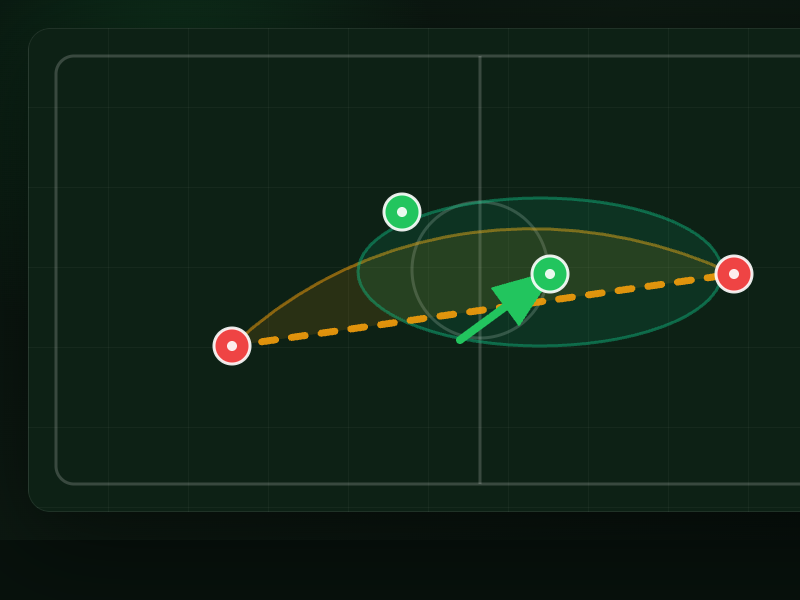
Short version: if opponents keep passing through your midfield in eFootball, the problem is usually not only player speed. It is the way you read the attack. Mednasah’s masterclass is built around one core idea: stop reacting to the ball after it moves and start defending the passing lane before the opponent commits.
This guide turns that idea into a practical defensive system. The goal is not to spam tackles or chase every ball carrier. The goal is to understand intention, close space, use Match-up to stabilize body shape, switch manually before the pass arrives, and combine second-man press with your own lane coverage.
The mistake: watching the ball instead of the intention
Most players defend one step late. They see the pass animation and then start moving. At high level that is already too slow. Mednasah’s point is that every build-up has only a few realistic options. Look at the ball carrier’s body angle, the nearby runners and the opponent’s formation. If the midfielder opens toward the wing, wide pass is likely. If the striker makes a diagonal run, prepare for the through ball.
The first improvement is mental. Do not lock your eyes only on the ball or your own defender. Control your player calmly enough that your eyes can scan the pitch. Once you move from “where is the ball?” to “what does he want next?”, interceptions become predictable rather than random.
Defend space, not only players
Interceptions start with space. When the ball is central, do not dive in automatically. Slide into the passing lane, stay square to the play and remove the easy option. You are not trying to win the ball instantly; you are shrinking the triangle between passer, receiver and defender until the pass becomes uncomfortable.

The defender should often move diagonally, not straight at the ball. That small angle is what lets you bait the safe pass while secretly standing in its path. Against possession players this is especially powerful because their patterns are repeatable. Close the first safe outlet often enough and hesitation enters the match.
Match-up is a body-shape tool
Match-up is not a panic button. On console, use R2 or RT; on mobile, use the Match-up button. The purpose is to keep the defender compact, balanced and square inside the passing lane. Sprinting blindly makes you overrun the lane. Light Match-up control helps the interception animation trigger cleaner because your player is already set.
Use it when you are near the lane, not when you are completely out of position. Small left-stick adjustments plus Match-up are more valuable than a late sprint. The difference is simple: you stop chasing the ball and start receiving it.
Second-man press: let AI pressure, you cover the exit
A major Mednasah concept is the trap: call second-man press, but do not control the presser. Let AI apply pressure to the ball carrier while you control the escape route. If the opponent feels pressure and the obvious pass is covered, the next mistake is often handed to you.

This is not chaotic pressing. If both defenders run at the ball, the midfield opens. If one presses and one covers the lane, the opponent is forced into the pass you are waiting for. That is why interceptions also become psychological pressure: the easy options disappear and the opponent starts taking extra touches.
Why the Interception skill matters
Positioning is the foundation, but player skills still matter. The in-game Interception skill improves reaction to passes and makes clean wins more consistent. Two players can stand in the same spot and the one with the right skill profile will often win the ball more reliably. For DMF and CMF roles, combine your technique with Interception, Blocker, defensive awareness and balance.
Manual switching wins milliseconds
Late switching opens lanes. Random switching collapses shape. Mednasah recommends manual switching: right stick on console, directional swipe on mobile. Start switching while the ball is travelling, or even when the pass animation begins. Those milliseconds decide whether you arrive before the receiver or after him.
Relying only on L1 or simple tapping is too vague for advanced defending. Use it sometimes, but make right-stick or swipe switching your default for interception situations. Precision gives you control over the exact defender who can kill the pass.
Stopping one-twos and through balls
Against one-twos, do not chase the first passer. The first pass has already happened. Switch toward the return lane and cut the second pass. That is the pass that breaks passive defenders.

Through balls require the same early thinking. Do not sprint after the striker in panic. Switch early, drop manually and angle your defender between striker and goal. Let the pass run into your path instead of turning the situation into a foot race.
Training routine
Practice it like a skill
- Play training or event matches with one rule: win the ball by interceptions only.
- Avoid tackle spam so your brain has to read lanes and body shape.
- Use second-man press for pressure while you manually cover the outlet pass.
- After matches, review conceded goals and ask which lane you left open.
- Train one detail at a time: Match-up angle, manual switch timing or one-two return lanes.
Common mistakes that kill interceptions
- Sprinting directly at the ball carrier and opening the pass behind your own midfielder.
- Holding Match-up too far away from the action before the defender is actually in the lane.
- Switching after the receiver has already controlled the ball instead of switching while the pass travels.
- Chasing the first one-two passer and leaving the return lane completely free.
- Forcing the first pass after an interception before the winning animation has settled.
The last point is easy to overlook. A good interception is not finished the moment the ball touches your defender. If you immediately force a vertical pass, you often give the ball back while your player is still turning or stabilizing. Take the first safe touch, play sideways when needed, and let the defensive win become controlled possession.
This also changes how you choose midfielders. Speed helps, but Mednasah’s logic rewards players who combine defensive awareness, balance, Interception and Blocker. A DMF with the right skills can turn a correct position into a clean ball win more often. Technique creates the chance; the player profile raises the success rate.
Final verdict
Mednasah’s method matters because it is not a single trick. It changes the order of defending: read intention, choose the lane, switch early, stabilize with Match-up, then take the ball. Once that sequence becomes automatic, you stop chasing shadows and start dictating where the opponent is allowed to play.